Lesson 5 of 12
How the card works
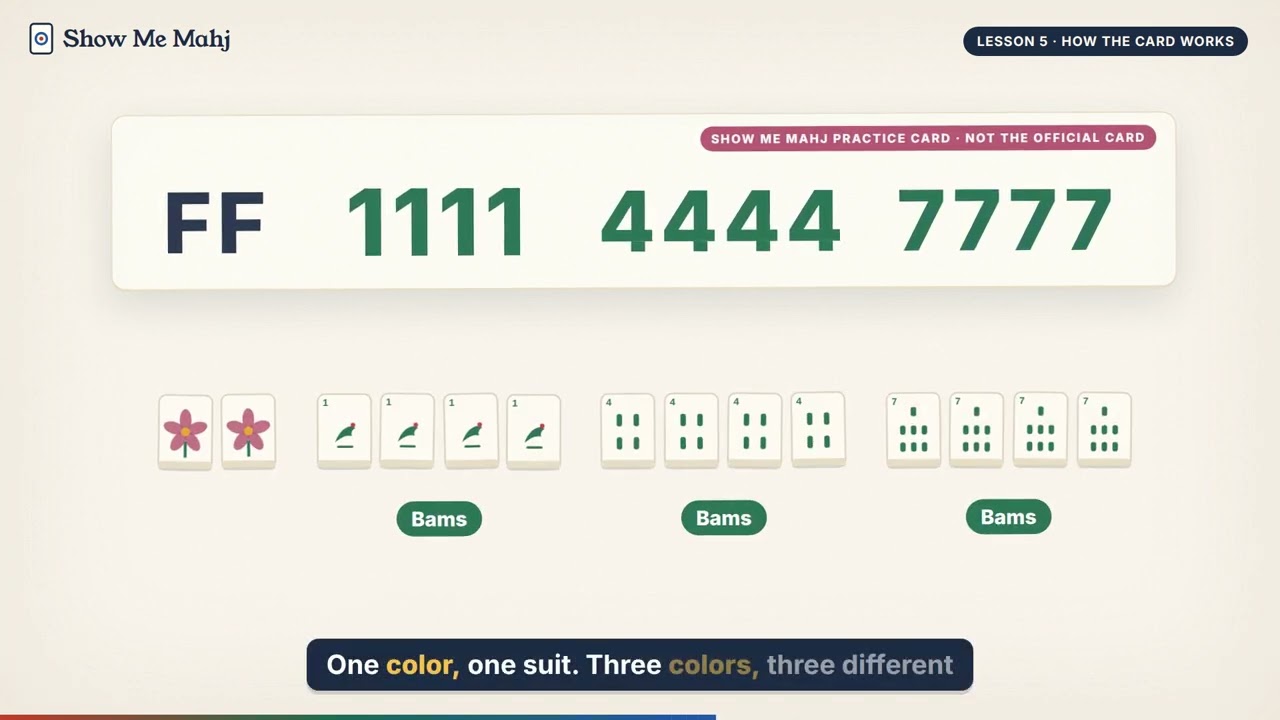
The National Mah Jongg League card lists every winning hand for the year, grouped into sections such as even numbers, odd numbers, consecutive runs and winds and dragons. Colours tell you how many suits a hand uses, an X means the hand may be exposed, a C means it must stay concealed, and the number on the right is what the hand pays.
Step by step
- Buy the real card. The card is published by the National Mah Jongg League each spring and is copyrighted. Every player needs their own; buy it directly from the League (there's a large-print version too). We never reproduce its hands.
- Sections. Hands are grouped into sections with a theme, for example the year, even numbers (2, 4, 6, 8), odd numbers, consecutive runs, quints, winds and dragons, and singles and pairs.
- Colours mean suits. Tiles printed in one colour must all come from one suit. A hand printed in two colours uses two different suits, and three colours means three suits. The colours don't mean specific suits; you choose which.
- X and C. X (exposed) means you may call discards and show groups on your rack. C (concealed) means you must build the whole hand from the wall and your own tiles, except the final tile for mahjong.
- Values. The number beside each hand (usually 25 to 50 or more) is what it pays. Harder and concealed hands pay more.
Common mistakes
- Reading colours as fixed suits ("green means Bams"). Colours only show how many suits and which tiles share one.
- Photocopying or sharing pictures of the card: it's copyrighted.
Words from this lesson
Card · NMJL · Exposed (X) · Concealed (C) · Section
Questions people ask
When does the new mahjong card come out?
The National Mah Jongg League releases a new card each spring, and players switch to it once it arrives.
Where do I buy the mahjong card?
From the National Mah Jongg League directly. Standard and large-print cards are available.
What does X and C mean on the mahjong card?
X means the hand can be exposed (you may call discards). C means the hand must be concealed.